About this collection
Orca Art Prints: Why a Whale Rises to Look at Our World
Every orca art print in this collection begins with a moment most of us never see. An orca lifts itself vertically out of the sea, holds its head above the surface, and looks around — at the ice, the shoreline, the boat, at us. Marine scientists call it a spyhop, and it is entirely deliberate.
What Is a Spyhop?
A spyhop is an orca rising slowly and vertically out of the water until its eye clears the surface, then holding that position long enough to look at the world above the waterline. It is not a breach. A breach is momentum and spray and the whole body thrown clear; a spy hop is control — the tail and pectoral fins working quietly underneath to hold the animal upright and almost still.
An orca does it for the same reason we stand on tiptoe. Above the water there is information it cannot get from below: a seal resting on an ice floe, movement along a beach, the shape of a hull, the position of the rest of the pod. Because an orca can see clearly in air as well as in water, that raised eye is genuinely reading the scene. Watch it happen once and it is difficult to shake — the unmistakable sense of being assessed by something that has decided you are worth assessing.
The Dorsal Fin: How to Read an Orca From the Surface
Most encounters with orcas are encounters with a dorsal fin. It is usually the first thing to break the surface and often the only thing anyone sees, so it is worth knowing how to read.
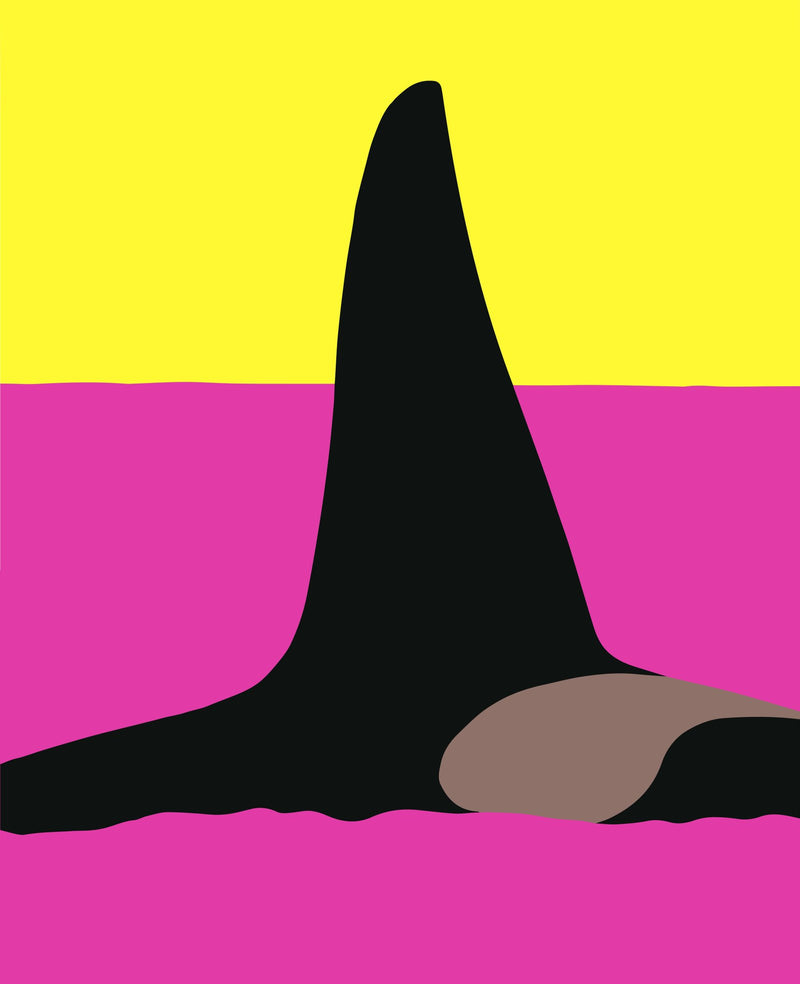
The dorsal fin of a mature male is tall, straight and startling — reaching around 1.8 metres in the largest bulls, standing almost upright out of the water. Females and juveniles carry a shorter fin with a distinct backward curve, which is why a young male's fin slowly straightening as he matures is one of the clearest signs of an orca growing up. The fin itself is a record of a life: nicks along the trailing edge, scars, tears and the shape of the pale saddle patch behind it are individual enough that researchers use them to identify particular animals and follow families across decades. No two are the same, which is precisely what makes a fin worth putting on a wall.
Two Ways of Seeing the Same Animal
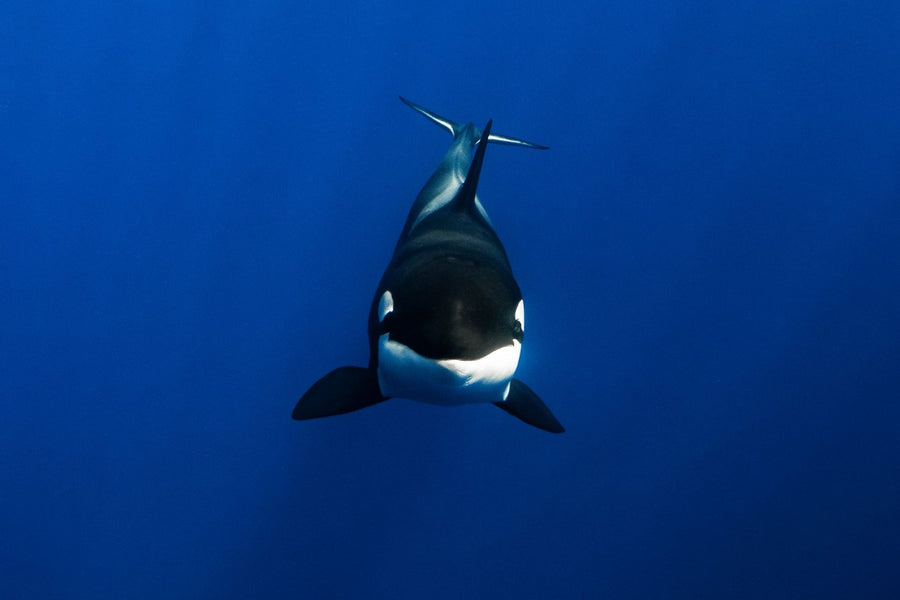
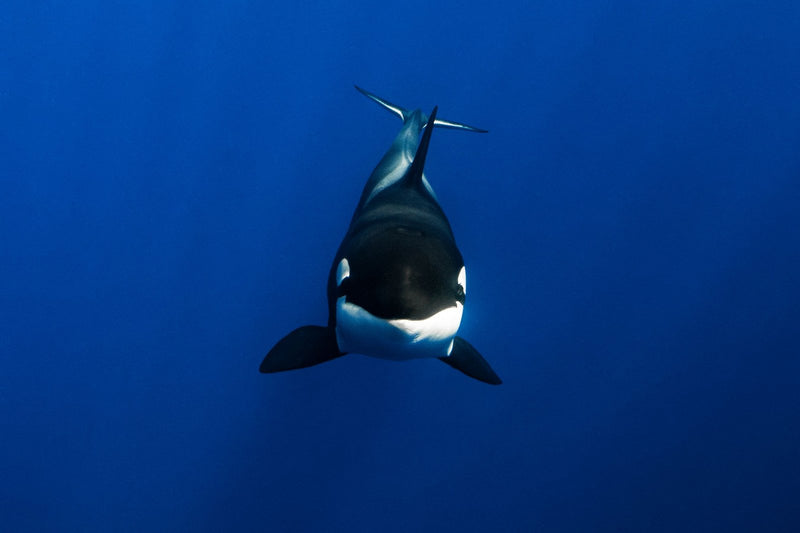
This is a small collection with an interesting split in it. Jake Wilton works with a camera, and his orca is a photograph — a real animal, in real water, on a day that happened. Ian Daniell works as an illustrator, and his spyhop and his dorsal fin are drawn: the same species rendered as shape, colour and edge, pared back to what the eye remembers rather than what the lens recorded. Hung together they do something neither does alone, which is why we would encourage you to look at all three before choosing.
Whichever you choose, the orca artwork is released as a limited edition, printed to order and handmade in Australia, and arrives with its certificate of authenticity. 30% of profits from every piece goes to the conservation causes we support — the reason most of us are here in the first place.
Start with The Orca by Jake Wilton, then see how differently the same animal reads in Ian Daniell's The Spyhop and The Dorsal Fin. On every product page, use View in room to place the piece on your own wall at true scale before you commit — it settles the size question faster than any measurement. If you are drawn to the bigger end of the range, any Extra Large or larger order comes with a complimentary small print of your choosing, which is how most collections quietly begin. And if it is the whales that have you here, keep going through Whale and Humpback Whale.

Canvas or fine-art paper: which should I choose?
Stretched canvas gives a gallery depth with no frame and is the recommended finish. Hahnemühle Hemp paper gives a lightly textured, archival print for your own framing, or in our oak frame.
Which size suits my wall?
Above a two-seater sofa (180–210 cm) most collectors choose 26″ × 40″ or 20 × 30. Use “Find your piece” or the scale slide on any artwork.
How limited are the editions?
Each size is limited to 111 numbered prints and never reprinted.
How long does delivery take?
Made to order: produced in 3–5 business days, then 5–7 business days for shipping. Rolled prints ship free within Australia. Framed and stretched pieces are A$10 flat delivery per order.
Can I return it?
Because each piece is made to order we don’t offer change-of-mind returns. If it arrives damaged, send a photo within 48 hours and we replace it.
Do you ship internationally?
Yes. Rates are calculated at checkout by destination.