About this collection
Cheetah Art Prints: The Cat Built for One Extraordinary Minute
Every cheetah art print in this collection is a photograph of the fastest land animal alive — a cat built so completely around acceleration that almost everything else about it, including its claws, its tail and the black lines down its face, exists to serve a sprint that lasts under a minute.
How Fast Is a Cheetah?
A cheetah runs at roughly 100 to 120 kilometres an hour, and only in short bursts — a few hundred metres at most before it has to stop. The top speed is the famous part. The engineering underneath it is the interesting part.
The spine flexes like a bow, folding and extending with every stride so the animal covers extraordinary ground per bound. The long tail swings as a counterweight, letting it change direction at speed without losing its feet. Enlarged nasal passages, heart and lungs move oxygen fast enough to keep the sprint alive. And unlike other big cats, a cheetah cannot fully sheathe its claws — they stay out, biting into the ground like a sprinter's spikes.
The cost is real. The chase leaves the animal overheated and spent, needing to rest before it can eat, and vulnerable in that window to larger predators that would happily take the kill. Everything a cheetah is has been traded for that one minute.
Cheetah vs Leopard: How to Tell Them Apart
Mistaking one for the other is easy from a distance and impossible up close, and the markings settle it fastest.
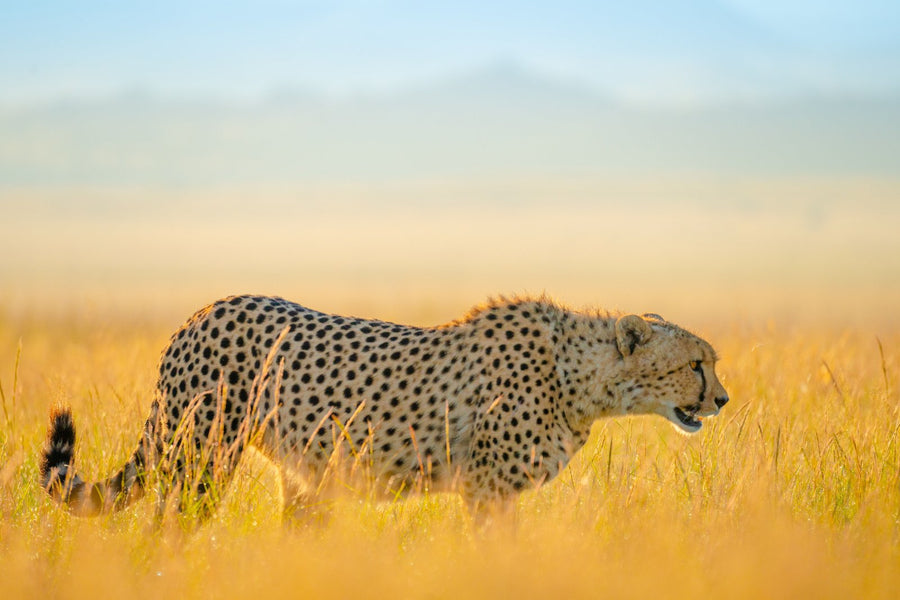
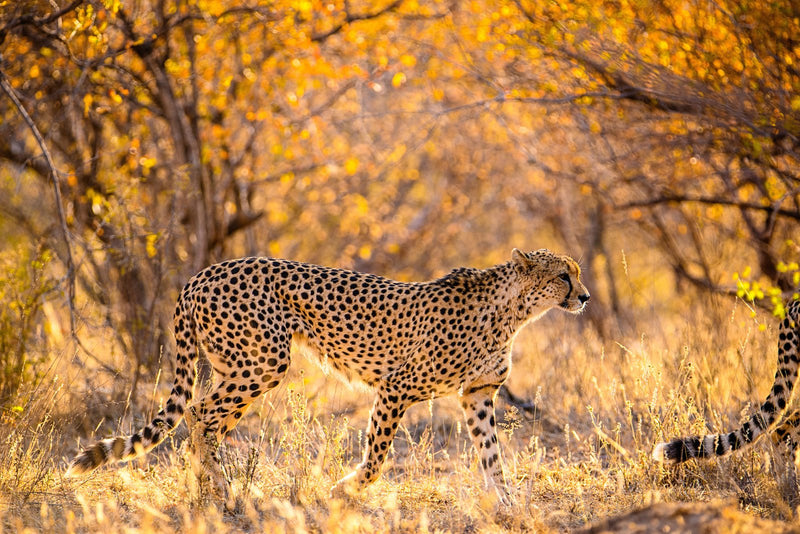
A cheetah wears solid black spots — round, separate, evenly scattered. A leopard wears rosettes: broken rings of black enclosing a patch of darker gold, like a spot that has opened out. Then look at the face. Only the cheetah carries the black tear lines running from the inner corner of each eye down to the mouth, a marking so distinctive it is the single most reliable field identification there is.
The build tells you the rest. A cheetah is light and leggy with a deep, narrow chest and a small high-set head — a greyhound of a cat, made for speed in open country. A leopard is heavier, thicker through the shoulders and built for power and climbing, strong enough to haul a kill up into a tree and hold it there. One is a sprinter. The other is a weightlifter.
Five Photographs, One Photographer
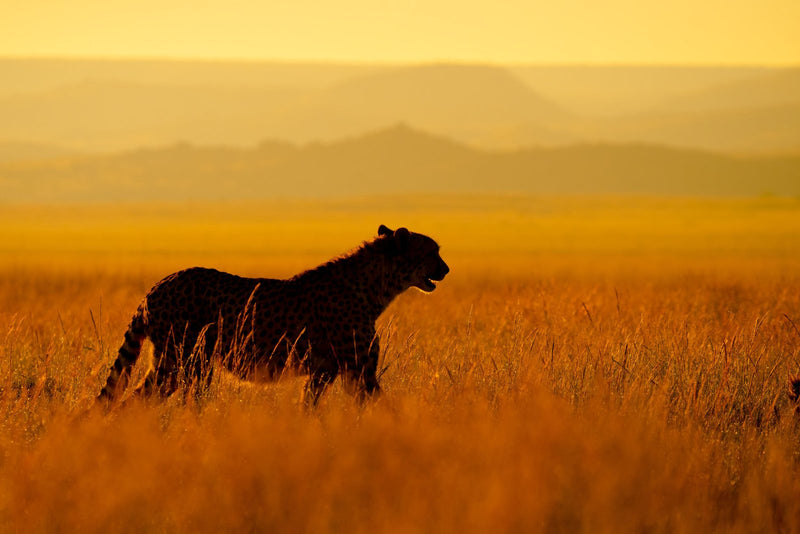
Every piece in this collection is the work of Shannon Wild, a wildlife photographer based in South Africa who has spent years in the field with big cats. That matters more than it might sound. Cheetah photography of this kind is not a lucky afternoon; it is time, distance, patience and a relationship with an animal's habits, which is why these five frames read as character studies rather than sightings — a cat hunting, a cat resting, a cat looking straight down the lens.
Each cheetah wall art piece is released as a limited edition, printed to order and handmade in Australia, and arrives with its certificate of authenticity. 30% of profits from every print goes to the conservation causes we support — and for a species under real and continuing pressure across its range, that is the point of hanging it.
Start with The Hunting if you want the animal in motion, or The Gracious and The Elegant if you want stillness. The Cheeky and The Beautiful are the two that tend to go into living rooms. On every product page, use View in room to place the piece at true scale on your own wall before you choose a size — with a cat this long, the format matters as much as the dimensions. Any Extra Large or larger order comes with a complimentary small print of your choosing. When you are ready to go wider, Leopard is the natural next look, and Land holds the rest of the wild places we work in.



Canvas or fine-art paper: which should I choose?
Stretched canvas gives a gallery depth with no frame and is the recommended finish. Hahnemühle Hemp paper gives a lightly textured, archival print for your own framing, or in our oak frame.
Which size suits my wall?
Above a two-seater sofa (180–210 cm) most collectors choose 26″ × 40″ or 20 × 30. Use “Find your piece” or the scale slide on any artwork.
How limited are the editions?
Each size is limited to 111 numbered prints and never reprinted.
How long does delivery take?
Made to order: produced in 3–5 business days, then 5–7 business days for shipping. Rolled prints ship free within Australia. Framed and stretched pieces are A$10 flat delivery per order.
Can I return it?
Because each piece is made to order we don’t offer change-of-mind returns. If it arrives damaged, send a photo within 48 hours and we replace it.
Do you ship internationally?
Yes. Rates are calculated at checkout by destination.