About this collection
Leopard Art Print: Learning to Read the Rosettes
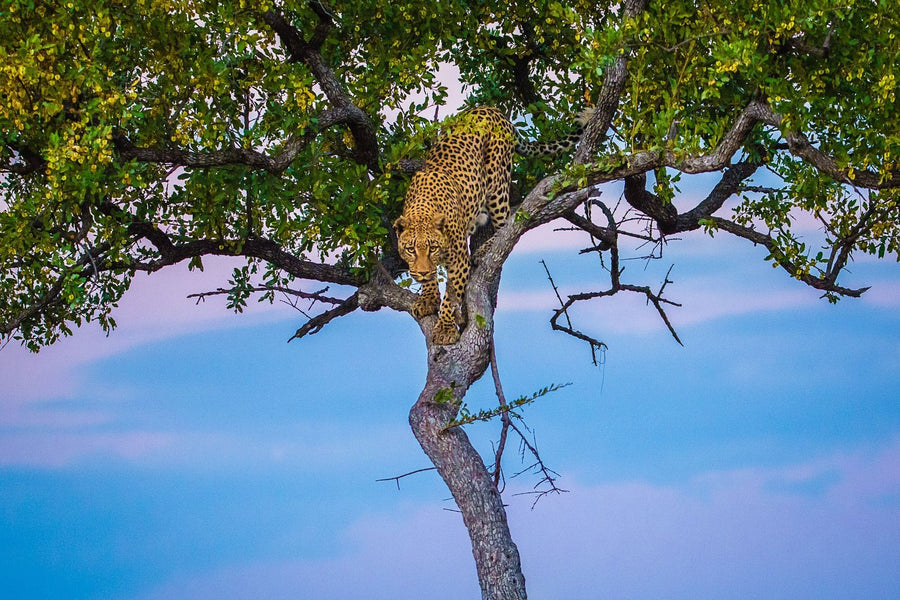
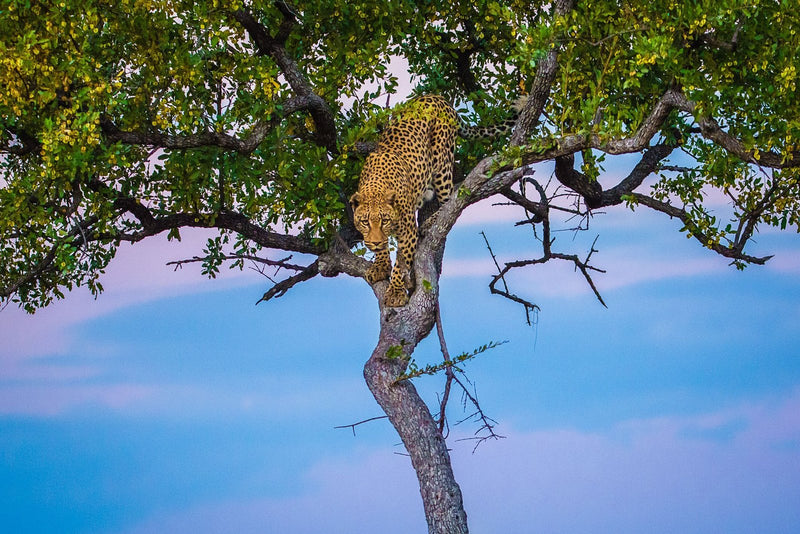
This leopard art print is a single work — The Bee Line by wildlife photographer and filmmaker Shannon Wild. One piece, and one of the few animals whose coat is also its identity document.
Leopard rosettes versus cheetah spots
The quickest way to tell the two apart is to stop looking at the shape of the animal and look at the marks. A leopard wears rosettes: irregular rings of dark spots enclosing a patch of coat slightly warmer than the background, like a footprint pressed into gold. A cheetah wears spots — solid, round, evenly scattered, no ring and no centre. From there it cascades. The cheetah has a black tear line running from the inside of each eye down to the mouth; the leopard has nothing of the kind. The cheetah is built long and light for a sprint measured in seconds. The leopard is built short and heavy for climbing, and will haul a kill up into the fork of a tree to keep it away from everything else. Same colour palette, entirely different animals.
One piece, and we'll say so
There is one leopard wall art piece in this collection. That is honest scarcity rather than a thin shelf — everything we release is a limited edition, and we would rather a single work stood on its own than fill a grid around it. The Bee Line is made to order and handmade in Australia, and arrives with a certificate of authenticity. Choose Fine Art Paper or Museum Grade Canvas across six sizes, framed or unframed. 30% of profits from this piece goes to the conservation causes we work with.
Open The Bee Line and use View in room to place it on your own wall at true scale before you decide — it answers the size question in seconds. Order an Extra Large or larger and you'll choose a complimentary small print to go with it. Now that you can read the difference, go and test it: the solid spots are in Cheetah, the rest of the big cats in Lion, and the wider savanna in Land.
Canvas or fine-art paper: which should I choose?
Stretched canvas gives a gallery depth with no frame and is the recommended finish. Hahnemühle Hemp paper gives a lightly textured, archival print for your own framing, or in our oak frame.
Which size suits my wall?
Above a two-seater sofa (180–210 cm) most collectors choose 26″ × 40″ or 20 × 30. Use “Find your piece” or the scale slide on any artwork.
How limited are the editions?
Each size is limited to 111 numbered prints and never reprinted.
How long does delivery take?
Made to order: produced in 3–5 business days, then 5–7 business days for shipping. Rolled prints ship free within Australia. Framed and stretched pieces are A$10 flat delivery per order.
Can I return it?
Because each piece is made to order we don’t offer change-of-mind returns. If it arrives damaged, send a photo within 48 hours and we replace it.
Do you ship internationally?
Yes. Rates are calculated at checkout by destination.
Canvas or fine-art paper: which should I choose?
Stretched canvas gives a gallery depth with no frame and is the recommended finish. Hahnemühle Hemp paper gives a lightly textured, archival print for your own framing, or in our oak frame.
Which size suits my wall?
Above a two-seater sofa (180–210 cm) most collectors choose 26″ × 40″ or 20 × 30. Use “Find your piece” or the scale slide on any artwork.
How limited are the editions?
Each size is limited to 111 numbered prints and never reprinted.
How long does delivery take?
Made to order: produced in 3–5 business days, then 5–7 business days for shipping. Rolled prints ship free within Australia. Framed and stretched pieces are A$10 flat delivery per order.
Can I return it?
Because each piece is made to order we don’t offer change-of-mind returns. If it arrives damaged, send a photo within 48 hours and we replace it.
Do you ship internationally?
Yes. Rates are calculated at checkout by destination.